Showing posts with label Miyagi. Show all posts

Tuesday, May 10, 2011

Very Interesting Take on "Flyjin" & One More

The Flyjin phenomenon in Japan has many facets. Generally speaking, Flyjin is a term used as a play on words in Japan. Gaijin is the word for foreigner. "Gai" means "outside" and "jin" means "person." So Gaijin means outside person or foreigner.
お江戸の火消し
SMOKE ON THE WATER
The Flyjin came in as an insult and joke deriding many of these foreigners who panicked and left places like Tokyo and Nagoya during the Fukushima accident. It is especially a dig at those who panicked and left co-workers, friends and neighbors (lovers too) holding the bag. It is not targeted at the foreigners who were in the disaster areas who left Japan. Only foreigners who were hundreds of miles away who panicked and fled - many even though their own embassies told them Tokyo was safe.


Nikkei Newspaper, though, has an article about foreigners who have left Japan that is looking at the problem from a totally different perspective. Even though many Flyjin get their feathers ruffled at the insinuation that they showed poor leadership and weak crisis assessment abilities, this article deals with a completely different segment of the foreigner in Japan market. It actually deals with a much larger workforce in Japan than the few westerners (who will most assuredly get angry about this article) that have been brought up in a society that makes people think they are entitled to everything.    
    
The title of the article asks Japanese people, "Do you think that only Japanese workers can protect your workplace?" From Nikkei:


震災と原発問題で日本を離れた外国人労働者たち。そこで突きつけられた問題がある。多くの職場で外国人が不可欠である現実と、彼らを身勝手に使ってきたという事実だ。外国人労働力を日本社会でどう位置づけるか。この問題に今こそ正対する時だ。...
Translation:
Many foreigners left their workplaces after the earthquake and due to (Fukushima) nuclear problems. This leaves us with many issues to consider. The reality of the situation in the workplace is that we (Japanese) have been using this (cheap) foreign labor selfishly. Perhaps it is time to consider how these foreign laborers are placed and viewed in Japanese society. Now could be a good time to consider this issue.
Japanese factories have a serious problem without cheap foreign labor
The article goes on to discuss how, due to a rapidly aging population and declining birth rate, Japan desperately needs these people to perform manual labor duties in order for the Japanese economy to run.
While many foreigners might cheer and raise their fists reading this and scream, "Right on! We are taken advantage of in the workplace!" This article is generally not about the highly paid westerners working in Japan. No. Not hardly. It is an article discussing a much larger and much more important labor force in Japan: cheap manual labor from China, Pakistan, Iran and many other southeast Asian nations.
It continues on talking about how Japan must open up more and take better care of these people who come to earn a living in Japan. They are not just cheap labor, they are a critical and important part of the labor equation for a healthy Japanese economy. They deserve to be treated better.
The other story I wanted to mention was about a president of a factory in the Fukushima area that hired many of these people as cheap labor from China.
Because of a bad past history and, in many cases, the Japanese management taking advantage of cheap foreign labor like mentioned above (but, then again, in what country don't they do that?) Japan and Japanese companies often have a bad reputation amongst Chinese workers. 
It is most likely deserved in many cases.
But there's a story about a Japanese president of a factory that risked his life to save some Chinese factory workers who were staying at the company dormitory near Miyagi or Fukushima when the earthquake and  tsunami hit. 
Anyway, this president heard about the tsunami warnings and realized that he had several Chinese workers staying at the company dormitory and that this dormitory was in the path of the tsunami. People were told to evacuate immediately and head for higher ground. But the president knew that these workers wouldn't understand the announcements and so he risked his life and drove full speed ahead to the dorm and got those workers out of there and saved their lives.
Soon after the Chinese workers left Japan (because of Fukushima) but, according to the article, they reported back in China that, "Not all Japanese company president's are bad guys" and that their company president risked his life to save theirs and they were grateful.
I looked for the article about this story, but am unable to find it. If I find it later, I will paste it into this post.
The moral of the story? Not all Japanese bosses are bad guys. Not all Flyjins are westerners and not all of them are bad guys either.

Saturday, April 9, 2011

Japan's Disaster True Ground Zero - Not Nuclear Power Plants

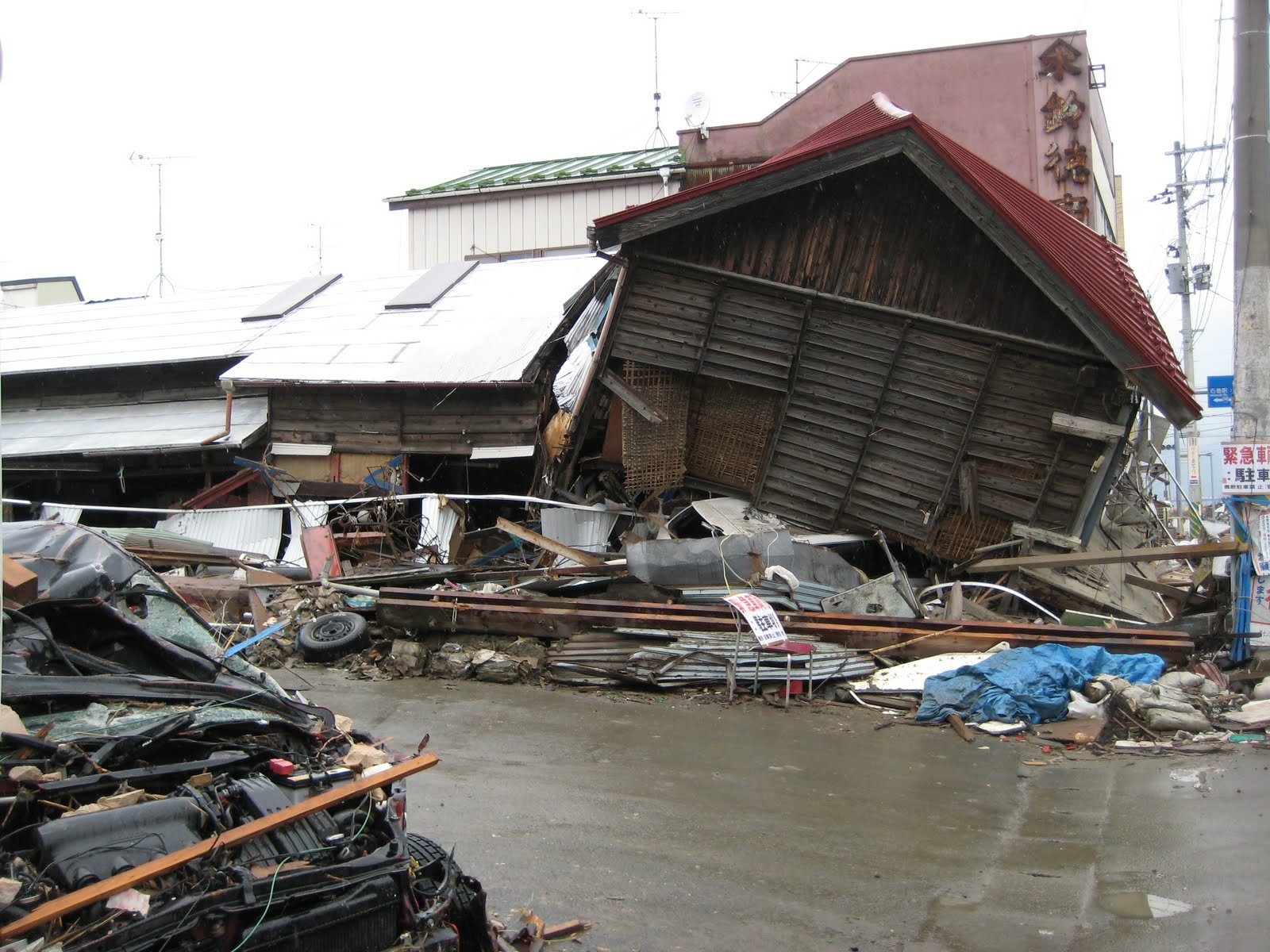
Today I went with 4 friends to deliver relief supplies to Ishinomaki in Miyagi prefecture in Japan. Ishinomaki and Kesenuma were ground zero for the earthquake and tsunami.


Even though many foreigners in Tokyo freaked out and ran out in an irrational panic, there are still a very many who want to be a part of, and help, the Japanese community as this is our home for better or worse (also because Ishinomaki and Kesenuma really are "Ground Zero" for the disaster).


In Ishinomaki and Kesenuma - and surrounding areas - over 27,800 people have lost their lives or disappeared.... The nuclear accident in Fukushima, while serious, is still only responsible for zero deaths and six injured (all who have been released from hospital with no expected complications).


My friends, Michio Hashimoto, Timo Budow, Ken Nishikawa and Roger Marshall all pitched in for the effort.


Michio took the photos below.


These photos say it all. Being at Ishinomkai and walking around and taking pictures and breathing the air was like a bad dream: Everything was covered in black sh*t and it smelled like a plugged toilet on a dirty, swampy fishing boat; it was like a nightmare.


Whatever you touched - or didn't touch - it didn't matter: the wrenched smell and rancid seawater mixed with the stench of death... It permeated your nostrils and it permeated your clothes.


I think I will have to shower and scrub heavily for a week or more to maybe have a chance to cleanse this putrid odor from my body pores.


It didn't matter what you touched or felt; you started feeling and smelling like the stinking spoiled, polluted ocean and the odor of death.

Buildings destroyed and deserted

Cars somehow smashed under buildings

 40 meter long ships landed in neighborhoods that are 250 meters from the bay

Cars inside of shops

Slammed against light poles

The army runs baths that give warmth to over 200 people per day

On the front of the boat is spray-painted "Danger! Do not ride bikes!" 

Two lawn chairs sit undamaged while cars and boats pile upon one another

Notice the car at right

Several ships sit in the middle of streets near the crossways

Every street looks like this or worse

Ditto

Seemingly undamaged but completely abandoned... No electricity or water

View across the river
From the bridge looking towards the ocean (still about 6 kilometers away)

Looks like the view from Hiroshima Dome towards the ocean in 1945

Amazing that some buildings still stood

Houses near the waterfront are totalled

Entire business districts and neighborhoods destroyed

View from the side of a bridge over a river near Ishinomaki

Water heaters for Japanese military set up public baths

There's thousands of places like this with cars stacked on cars

There's thousands of places like this with ships sitting in the middle of neighborhoods all over, Ishinomaki, Kasenuma and other smaller towns and farms along the way. This is the real disaster.

Propeller of 10 tons ship sitting on main thoroughfare.

Mud and dirt caked over park near river

Typical case of rest area and/or park under a foot of mud

Like I said, there's ships like this everywhere

Car hanging over precipice about to fall into river

Finally, we delivered a two-ton truck of supplies to Sunnet Nagomi 
center for the disabled and handicapped in Ishinomaki

Sunnet Nagomi is a center to care for the handicapped and the aged. We delivered, stationary, boots, plastic goods, water and other supplies.

Tuesday, March 29, 2011

No Scientific or Medical Basis for Restrictions on Japan Travel & More

Once again, let's deal with just the facts concerning the nuclear accident in Fukushima, Japan. 
The fact of the matter is, folks, that there are too many pundits writing sensationalism about subjects they are not expert in and scaring people. I am not a nuclear power expert but I am an expert in mass media and know a BS story when I see one. And I've seen lots of them in these last 10 years or so: Swine Flu, SARS, Bird Flu, Man Made Global Warming. These mass media cretins pronounce this stuff as gospel truth, interjecting their scare tactic with words like, "might," may have," "could have"... etc. When it is all total conjecture and doesn't deserve to be on the pages of "respectable" media but rather on the pages of tabloid sensationalism. As Tech Crunch aptly put it:


This is all just going to get worse, because, increasingly, all stories are tech stories. Politics? Obama’s staggering online fundraising. Sports? BALCO and high-tech new equipment. Culture? These days, even fine art is all about the Arduino. Technology has insinuated itself into our lives to such an extent that every story now has a technical aspect — but yesterday’s dinosaur journalists will continue to write about them in the same clumsy-to-moronic way that they wrote about Fukushima.

Searching for more factual reporting from a reputable source about the safety of Japan. I found this: In an official public announcement from the International Maritime Organization, in spite of the scaremongering and sensationalism reported in the mainstream mass media (MSM) there is no basis for any medical restrictions to and from Japan regarding radiation or any other problems:


No Restrictions on Travel to Japan


International flight and maritime operations can continue normally into and out of Japan’s major airports and sea ports, excluding those damaged by the tsunami, according to the latest information available from the World Health Organization, the International Atomic Energy Agency, the World Meteorological Organization, the International Maritime Organization and the International Civil Aviation Organization. 

While there is currently no medical basis for imposing restrictions, the United Nations organizations are monitoring the situation closely and will advise of any changes.  

Screening for radiation of international passengers from Japan is not considered necessary at this time. Currently available information indicates that increased levels have been detected at some airports, but these do not represent any health risk. 

The page has a link to the World Health Organization's site. The link is broken. I searched, Japan Nuclear Concerns and found this FAQ page:


What is the current risk of radiation-related health problems in Japan for those residing near the reactor in comparison to those in other parts of Japan?

  • Radiation-related health consequences will depend on exposure, which is dependant on several things, including: the amount and type of radiation released from the reactor; weather conditions, such as wind and rain; a person’s proximity to the plant; and the amount of time spent in irradiated areas.
  • The Government of Japan’s recent actions in response to events at the Fukushima Daiichi nuclear power plant are in line with the existing recommendations for radiation exposure. The Government has evacuated individuals who were living within a 20-kilometre radius around the Fukushima Daiichi plant. Those living between 20 km and 30 km from the plant are being asked to shelter indoors. People living farther away are at lower risk than those who live nearby.
  • As and if the situation changes, the Government of Japan may change their advice to the public; WHO is following the situation closely.
In short, the risk near the reactor exists. The exclusion zone of 20 km ~ 30 km (12 miles ~ 18 miles) are in line with existing recommendations for radiation exposure. Once again, Tokyo is about 150 miles away. Common sense should prevail in helping you to avoid any risk. The article goes on to talk about food contamination:
  

Is there a risk of radioactive exposure from food contamination?

  • Yes, there is a risk of exposure as a result of contamination in food.
  • However, contaminated food would have to be consumed over prolonged periods to represent a risk to human health.
  • The presence of radioactivity in some vegetables and milk has been confirmed and some of the initial food monitoring results show radioactive iodine detected in concentrations above Japanese regulatory limits. Radioactive caesium has also been detected.
  • Local government authorities have advised residents to avoid these food and have implemented measures to prevent their sale and distribution.

The last two bullet points are important here. The final one says that the government has blocked sales of these foods and prevented their distribution. Translation: You can't buy this stuff legally, so if you don't eat it, there's no problem.


People worried about food safety are advised to search the USA Food & Drug Administrations sites about how many parts per million of rat excrement and bug parts are allowed in our food... You also won't ever want to eat out at a restaurant if you are worried about getting sick from your food either... Trust me, I worked at a restaurant when I was 18 years old. 


Reuters reports Deaths From Food Poisoning Under Reported


The Centers for Disease Control (CRC) in the United States estimate that about 5,200 people there die each year from food poisoning but the Danish researchers believe the true figure could be nearly twice as high.


Also, this delectable article on the FDA:  


An eruption at the Peanut Corporation of America led to at least 9 reported deaths, hundreds of diseases and a huge recall of product. Recently, bagged spinach, tomatoes, jalapenos and raw cookie dough have been linked with food borne diseases. For food safety, people have to follow the guidelines which are given by FDA. 


There's millions of articles like this available for anyone who wishes to do a Google search. Salmonella kills over 1,000 people a year alone in the USA. Deaths from eating radiated spinach or milk in Japan? Zero. 


Trust that this irradiated food has been destroyed and will never reach the market. Your chance of eating it and dying from it are about as high as your chances of winning the lottery. Once again, this is a non-story being inflated by an increasingly desperate mass media. 


HENRY ROLLINS - LIAR


You can read more from a technical publication that blasts this mass media sensationalism in: UK Tech Publication Blasts Sensationalist Reporting on Nuclear Reactor:


The situation at the quake- and tsunami-stricken Fukushima Daiichi nuclear powerplant in Japan was brought under control days ago. It remains the case as this is written that there have been no measurable radiological health consequences among workers at the plant or anybody else, and all indications are that this will remain the case. And yet media outlets around the world continue with desperate, increasingly hysterical and unscrupulous attempts to frame the situation as a crisis.


Crisis? Up north for the poor folks in Miyagi and Fukushima, yes. For us in Tokyo? No. Merely an inconvenience in spite of how much people want to believe the sensationalist shrill... 


Next up, killer flu coming to a neighborhood near you. 

Thursday, March 24, 2011

Fly-Jin Hits Even the Wall Street Journal

From the "They can run but they can't hide files;" as was reported in an editorial on this very blog on Sunday March 15 (just 3.5 days after the big earthquake), that the blow back from the panic and irresponsible reactions of foreign business management in Japan - at the beginning of the nuclear accident - was disgraceful and that there would be repercussions. 
FRANK SINATRA - COME FLY WITH ME
In some cases, the flight of the foreign community was a crime; it was dishonest and theft against their respective employers. It also first reported and predicted on this very blog that there was going to be blow back against these foreigners. In fact, even the Wall Street Journal has picked up on this story. Let me pat you and myself on the back for creating and commenting on this story nearly 2 weeks before the Wall Street Journal. Read on!


First, a time line. In an early post, just days after the earthquake and the height of the panic, I wrote about how the foreign community in Tokyo were being completely irrational by panicking and running away. This contributed to people missing the important issue: 400,000 people without shelter, food or water in the dead of winter in Northern Japan. The foreigners panicking was completely without base and any scientific reasoning.

Tokyo Crisis Update: Nuclear Meltdowns, Drama Queens, TV News and Coca Cola


I, like most Tokyo people, have merely been inconvenienced by this incredible chain of events. I do not think, though, that I should adopt a "victim complex" like many people do when these sorts of things occur. I think doing so is dishonest. I believe that taking a "victim complex" identity like many people do only cheapens the experience of those who have truly suffered.

One need only remember the group victim complex shown by Americans after 9/11 for an example of that. As for me, I'm doing my best to suppress my inner "Drama Queen." 

Folks in Tokyo have not suffered. We have been greatly inconvenienced. That's all. That's not to say that many people haven't over reacted and panicked. They have.

I will, here, take this chance to strongly criticize the foreign management of Coca-Cola Japan for showing such a compete lack of responsibility to their employees and to the Japanese people. So much for Corporate Social Responsibility, eh Coca-Cola? Also, so much for dedication to your work and company. Leaving on a "business trip"? Disgusting. Don't you clowns have the guts to even say that you are running away? Saying that it is a "business trip" allows you to get paid from your company at the same time you skirt your responsibilities all the while you expect that your staff and workers continue on like everyday? If I were your boss, we'd definitely have more than a few words about this. I'd probably fire you.

I can understand you sending your family away... But you running away too? And then expecting to get paid and your employees to carry on in your absence at the same time!?

Scandalous.


This theme held true throughout my blog posting over the next several days. I used a major soft drink company as an example (because I knew it was true first hand) as this is a huge international company, but there were many other  companies whose foreign management fall into the same category. I commented as to how actions by many foreigners and the mass media were criminal (at the best dishonest) and that these people who panicked or induced panic needed to be held accountable - at the minimum to themselves and their families - in some cases criminal. I definitively asked the question about trust between Japanese and the foreign management who in a grossly irresponsible manner left their companies - on paid leave no less - and jumped ship.


If these people really thought the situation was so bad and dangerous, then why didn't they tell their staff to go home and care for their families? 


(Note to selfish foreigner: Your Japanese staff think you are just like an irresponsible teenager, regardless of what they say to your face. Your position and status are worse than "dog house". The respect they held for you - if they ever had any - is completely compromised. Remember: It takes a very long time to build trust, it takes one action to destroy that trust forever.) 


What are you going to do about it, foreign manager? 


Japan Nuclear Disaster? The Scorecard So Far


What's going to happen to the relationship between the Japanese and the foreign community in Japan? I think the actions of many of the foreigners (not just in the media) have created much distrust and disrespect of those foreigners (especially in management) by their Japanese counter-parts. I already posted about one foreign company, Coca Cola, whose foreign upper-management committed the sin of running away while taking paid leave (isn't stealing from your own company considered theft?) while expecting the Japanese to continue working as if nothing at all happened?

If the situation were so bad and they bothered to make rational decisions - while showing a tiny bit of leadership qualities - then they'd have had the guts to say that they were running away and told the Japanese staff to go home; or they would have sent their families away and stayed with the ship. I know for first hand fact that the Japanese staff left over by their panicking foreign bosses have very little respect for those people. They probably should have zero; which were just about the odds of a nuclear disaster hitting Tokyo.


There are many foreigners who read this blog... About one half are in Japan. Why this shirking of duty was explained in excellent fashion by a reader living here in Japan. This brilliant and succinct explanation of the problem appeared in a comments section of one of my posts. The reader was countering the ridiculous argument that claimed that the foreigners who left were, "Forced out" it read:

The people who fled irresponsibly were not 'forced out' as you say. Panicked or not, they acted of their own free will, and left others hanging because of their actions.

Japanese do have respect, manners and kindness for others, and also a sense of responsibility and self-sacrifice. Example: the 'Fukushima 50'.

I have many friends and acquaintances in large corporations and government offices, and they all say that not one of their Japanese bosses fled in panic and left the rest to their fate. Do you know why?

Responsibility.

Think long and hard about that word before you bleat any more asininity.

One of the Japanese words for an executive, manager or other person in charge is 'sekininsha', which literally means 'responsible person'. These people are not just responsible for their workplaces and the people below them during fair weather; when the sh*t hits the fan, they are also expected to step up and take responsibility. That is to say, *leaders* are expected to *lead*.


Absolutely. Like I have already written, these people who panicked and left Tokyo in an irrational, irresponsible blur should resign their posts immediately if they are "sekininsha" (responsible person) at their job. Their position has been compromised. They are ruined and they know it.

But, I won't expect them to resign of their free will. They have already showed us their lack of true leadership abilities when they panicked and left. Who would or could expect them to act like a true dedicated leader like Jerome Chouchan of Godiva Chocolates who showed us his true grit?

Mr. Chouchan, a Frenchman, decided to send his family away but he stayed on because he said that he felt like, "If I leave now and leave my Japanese staff to fend for themselves it would be like the captain leaving the sinking ship first."

Soon after these blog posts ran, where I criticized these foreigners, I began taking flak from people defending the actions of these people. I think no one can defend the actions of those whom I attacked. Please read the interesting back and forth between the foreigners who agreed with me and those who wish to defend the actions of those who ran away on the articles that I have linked to. 

The discussion got even more heated when I reported as to how a new word, filled with derision against those who fled, had entered the Japanese lexicon and was hitting Twitter hard all over Japan lead by a famous Japanese TV reporter. 


New Word in Japanese Lexicon: "Fly-Jin"

Akiko Fujita tweets, Learned new term tonight: "Fly-Jin." Foreigners who fled Japan.

Also, in that article, once again I stressed:

The Japanese are not happy - some are disgusted -by the rash actions of the foreign community. They've lost much respect for those who fled like panic stricken kids. The back lash has begun. Whispered voices filled with derision and tittering behind people's backs.

Once again, a reader provided me with a better commentary about the subject than I could ever write in the comments section of that same post countering the apologists for the "Fly-Jins.":

What the Useful Idiots (uh oh, there I go calling names again) fail to understand is that there is a world of difference between getting yourself and family out of potential danger if you have the resources and inclination to do so, and running away irresponsibly at the expense of others like the Coca Cola execs and others did (i.e. lying to justify the expropriation of company funds for your escape, and leaving others you should be responsible for behind to cover your arse as you run).

I have no problem with the former, even if I think it was a knee-jerk panic reaction in this case. If you have the means to do so and your actions do not leave anyone hanging in your stead, knock yourself out. However, I do have a big problem with the latter, and will continue to criticize the actions of the Coca Cola execs and others who acted in such a cowardly and irresponsible manner.

So again, to make things as clear as possible:

If you fled in a responsible manner - that is to say within your own resources and not leaving others hanging in your stead - then I have no problem with you. I also have no problem with anyone defending those people, be they foreign or Japanese.

However, if you lied, stole, or otherwise acted irresponsibly and/or left others to potentially hang in your stead, then to hell with you. And to hell with anyone defending these scum.


Thanks to all of have added to this conversation. I stand by all my remarks as my excuse is that I was merely predicting what was going to happen and told of the future repercussions of failed leadership and poor decision making. I also am guilty of being the messenger boy. Of course, when those who are guilty, hate the message, they try to kill the messenger boy.


Now, the results of this shameful affair have even hit the pages of the Wall Street Journal.


The Wall Street Journal reports in "Expatriates Tiptoe Back Into the Office": 


Life in Japan is showing tentative signs of returning to normal, but a fresh challenge may be facing the expatriates and Japanese who left and are now trickling back to their offices: how to cope with ostracism and anger from their colleagues who have worked through the crisis.
One foreigner, a fluent Japanese speaker at a large Japanese company, said that his Japanese manager and colleagues were "furious" with him for moving to Osaka for three days last week and that he felt he was going to have to be very careful to avoid being ostracized upon returning to work in Tokyo.


The flight of the foreigners—known as gaijinin Japanese—has polarized some offices in Tokyo. Last week, departures from Japan reached a fever pitch after the U.S. Embassy unveiled a voluntary evacuation notice and sent in planes to ferry Americans to safe havens. In the exodus, a new term was coined for foreigners fleeing Japan: flyjin. 


Think about it: Everyone knows the government are idiots... You pride yourselves on being in private businesses yet when these clowns tell you to panic, you do? Really? I also remember when they told us about Swine Flu, SARS, Bird Flu and Saddam's Nooklar weapons too... And you fools believe what they say? Ha!


So, now, you foreigners who are apologists for those who shamefully ran away can complain to me or call me names all you want... What you say to me isn't going to do you any good in the minds fo your staff... I am not your judge; they are. 


You messed up big time and you know it. 


Still think you shouldn't feel ashamed? 


Denial isn't just a river in Egypt.


NOTE: I have information that Coca-Cola has donated $25 million dollars to the relief fund for those poor folks in Northern Japan. Thanks. Everything helps. It is appreciated. But, should we awe-struck? Maybe. Maybe not. 


Nice


I have information that I wish for you to use to compare. Try Uni-Qlo vs. Coca-Cola. There's no question as to which is the bigger monster company, right?


Uni-Qlo - a much smaller company than Coca-Cola - on March 14, 2011 - just three days after the earthquake - donated $4 million of dollars to the disaster fund. That same day, the president of Uni-Qlo, Mr. Yanagi, donated $10 million of dollars -  out of his own pocket for this effort! Add to that $7 million dollars worth of clothes to the relief effort. Also, a donation effort at 2,200 Uni-Qlo stores nationwide!  


Now compare that with the efforts of Coca-Cola who is a much bigger company with much more resources... Well, thanks Coca-Cola, but I'm not so impressed... Then again, I guess I should be grateful and can excuse you for not acting quickly. After all, your upper management in Japan had all ran away when they jumped ship at the beginning of this mess. I shouldn't expect that the Japanese middle management would have the authority to make donations or any other important leadership decisions. 


The Japanese staff can only be depended on for holding the bag - not the important decisions - while the foreigners run away..... right? 


A big thanks to alert reader Mark (still) in Tokyo Owens for the links to WSJ!
Related Posts Plugin for WordPress, Blogger...